
Why commercial fitness equipment buyers still care about selectorized machines
When a gym floor gets crowded, fitness equipment that is easy to understand matters almost as much as equipment that looks impressive. Selectorized strength machines are still a workhorse category for that reason. They give users a guided path, reduce setup time, and make it easier for staff to keep the training area moving. For commercial operators, that means fewer awkward starts, less intimidation for new members, and a better fit for rehab, hotel, and club environments where consistency counts.
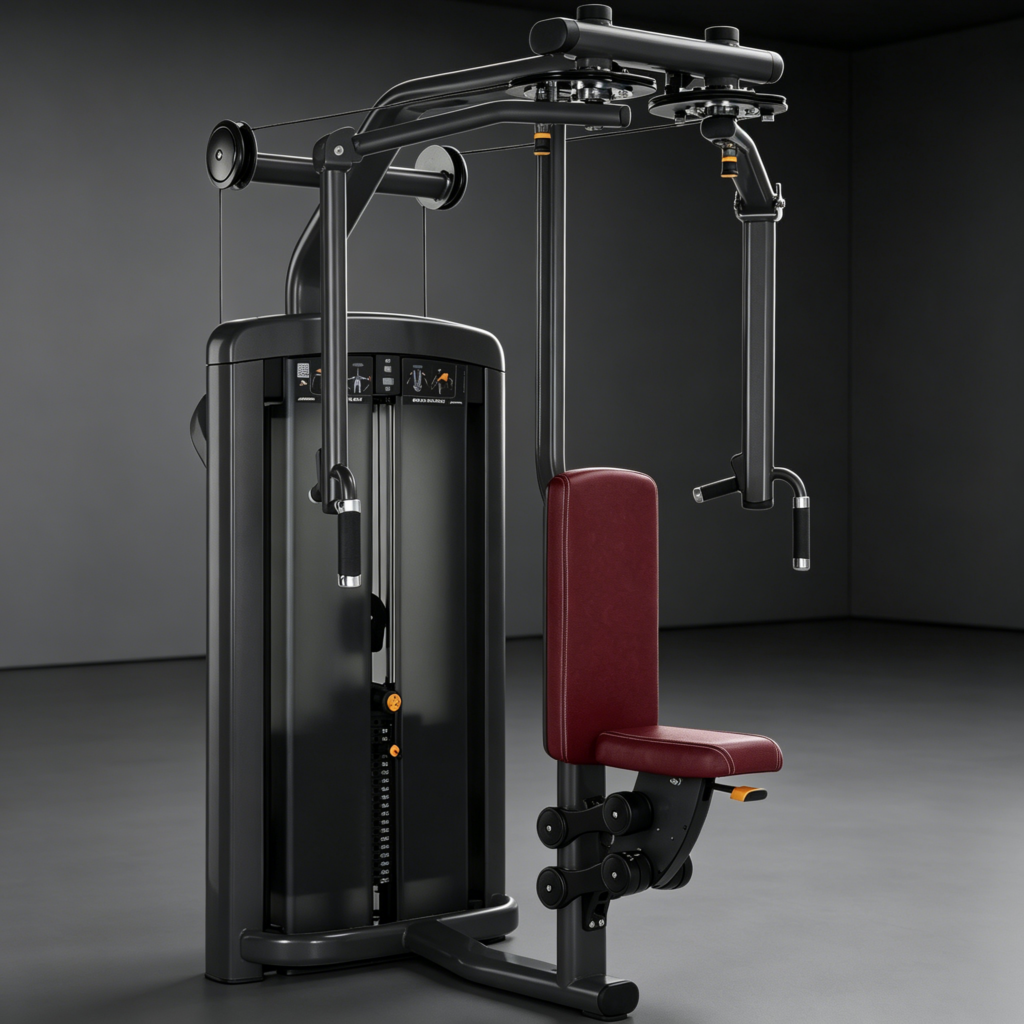
The machine in question appears to be a compact upper-body strength station built around a weight stack, seated pad, and dual moving arms or cable-driven handles. The exact exercise varies by setup, and that is worth noting: from the outside, it could be positioned for chest fly work, rear delt fly motion, or a pulling pattern such as a lat pulldown or seated row style movement. Buyers should read the design as a guided resistance platform rather than a single-purpose novelty piece.
What the visible design tells a sourcing team
The frame appears to be powder-coated steel in a dark finish, with a red upholstered seat and back pad. Those are ordinary details, but in a commercial setting they tell you a lot. Steel tubing suggests welded fabrication and a machine built for repeated daily use. The enclosed weight-stack housing suggests a safer selectorized format, especially for public gyms where exposed moving parts are a liability. The padded seat and back support also indicate a machine intended for controlled, seated exercise rather than explosive or free-range movement.
There are also visible handle positions and pivoting arm assemblies. That usually matters more than it first seems. Multiple grips and a compact pulley path can make the difference between a machine that serves only one user type and a machine that stays useful across different body sizes and training goals. In a busy facility, versatility often wins over a flashy but narrow design.
Quick buyer takeaways
If you are comparing this kind of station against other strength training equipment, the main questions are practical ones:
Does the machine support the movement patterns your members actually use?
Does the footprint fit your floor plan without crowding adjacent stations?
Can beginners understand the adjustment points quickly?
Does the enclosed stack and guided motion reduce supervision needs?
Those are more useful buying questions than chasing features that sound technical but do not change daily operation.
How this category fits alongside cardio equipment and free weights
Commercial buyers often compare strength stations not only with other resistance machines but with nearby cardio equipment and open training space. That comparison is useful because floor space is never unlimited. A selectorized machine like this one occupies less mental space than a free-weight bench setup; users can walk up, adjust the seat, choose a stack pin, and begin. By contrast, free weights offer broader movement freedom but require more instruction, more cleanup, and more supervision.
For facilities serving mixed audiences, the balance usually looks like this: cardio equipment for warm-up and conditioning, free weights for advanced training, and selectorized strength machines for accessibility, consistency, and controlled resistance. That mix is not glamorous, but it is what keeps a floor functional from morning to late evening.
Likely manufacturing elements behind the machine
Even without a brand plate or model sheet, the construction points to a familiar industrial process chain. Welded steel frame sections form the load-bearing skeleton. Machined pulleys, guide rods, and pivot joints handle motion. Sheet-metal shrouds or panels close off the weight stack area. Upholstered foam pads finish the contact points. Cable assemblies, if present, add the tension path and connect the user interface to the resistance source.
That combination is standard in commercial gym equipment manufacturing, but quality still varies in the details. Smooth pivot action, stable seat adjustment, clean welds, and serviceable hardware matter far more than a shiny brochure photo. Buyers should look closely at cable routing, access to maintenance points, and whether the machine is designed for easy inspection in a club environment.
Selection criteria that actually matter on the floor
Footprint and traffic flow
A compact footprint is valuable only if it does not create a bottleneck. Measure the surrounding clearance, not just the base dimensions.
User adjustment range
The visible seat adjustment suggests some adaptability, but the real question is whether the machine accommodates smaller and taller users without awkward shoulder positions or overextended reach.
Training intent
Some machines are better for chest isolation, others for upper-back pulling work. Do not assume universal use from one frame design. Ask how the arm path changes the exercise.
Serviceability
Commercial buyers should always ask how easy it is to inspect cables, pulleys, and stack guides. A machine that is simple to service usually stays on the floor longer.
Common mistakes when sourcing this type of strength machine
The most common mistake is buying for appearance instead of programming. A machine can look solid and still duplicate a movement already covered elsewhere in the room. Another mistake is ignoring the user base. A rehab facility, for example, may value easier entry and more stable support than a high-throughput gym does.
It is also easy to overread the visible hardware. Dual arms and multiple grips suggest versatility, but they do not tell you the resistance curve, the stack weight, or the cable ratio. Those details are not visible here, and they should be confirmed before purchase rather than assumed.
Practical next step for buyers
If you are evaluating this category for a club, hotel gym, or training center, start by mapping the machine to actual member use. Decide whether you need a chest-focused station, a rear-shoulder isolation unit, or a pulling machine for back training. Then ask the supplier for the missing technical data: dimensions, resistance mechanism, adjustment range, maintenance access, and service parts support. That conversation will tell you more than a marketing sheet ever will.
For sourcing teams comparing strength training equipment lines, the best decision is usually the one that improves floor usability without creating service headaches. The right machine is not the one with the loudest feature list. It is the one staff can explain in ten seconds and maintain without drama.
FAQ
Is this machine mainly for chest or back training?
From the visible structure, it could support either, depending on the arm path and handle setup. The exact exercise cannot be confirmed from the image alone.
Is the resistance system plate-loaded or selectorized?
A visible weight stack suggests a selectorized system, but exact mechanism details should still be verified before buying.
Where does this type of machine fit best?
It fits well in commercial gyms, hotel gyms, rehab spaces, and institutional training rooms where guided movement and easy user onboarding are priorities.