
Why a plate-loaded leg press still matters in a crowded fitness equipment market
When buyers compare fitness equipment for a commercial gym, the conversation often jumps straight to treadmills, cable stations, and selectorized stacks. That makes sense on the surface. Those machines see constant use and are easy to explain to new members. But lower-body strength work is where a facility can quietly improve retention, training quality, and perceived value. A linear leg press or hack press style unit does that well because it gives users a guided, heavy-resistance movement without demanding the balance and technique of a free squat.
For sourcing managers and training-facility owners, the real question is not whether the machine looks impressive. It is whether it handles traffic, fits the room, and supports a training style members will actually use week after week. A machine like this also tells you something about a facility’s positioning. If you want serious lifters, athletic teams, or rehab clients to feel at home, lower-body strength training equipment deserves more floor space than it often gets.
What this machine is designed to solve
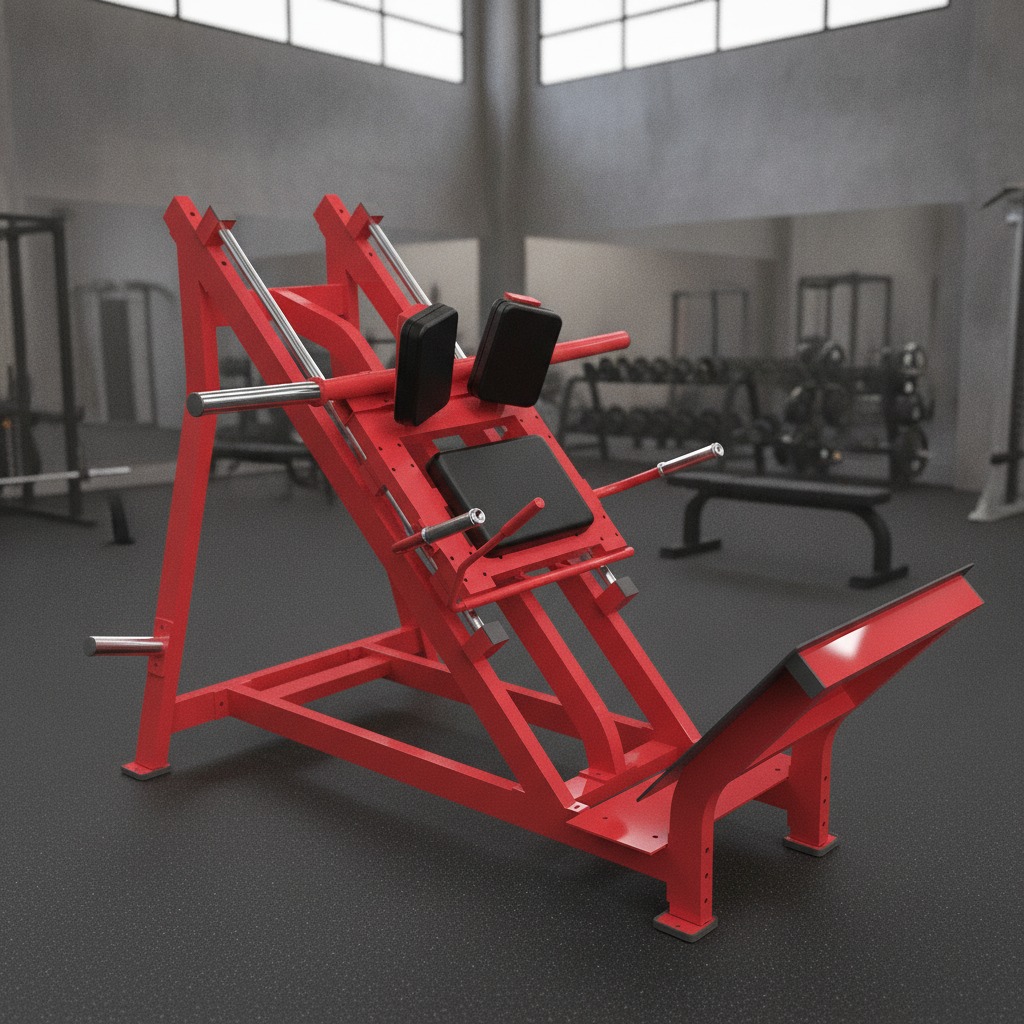
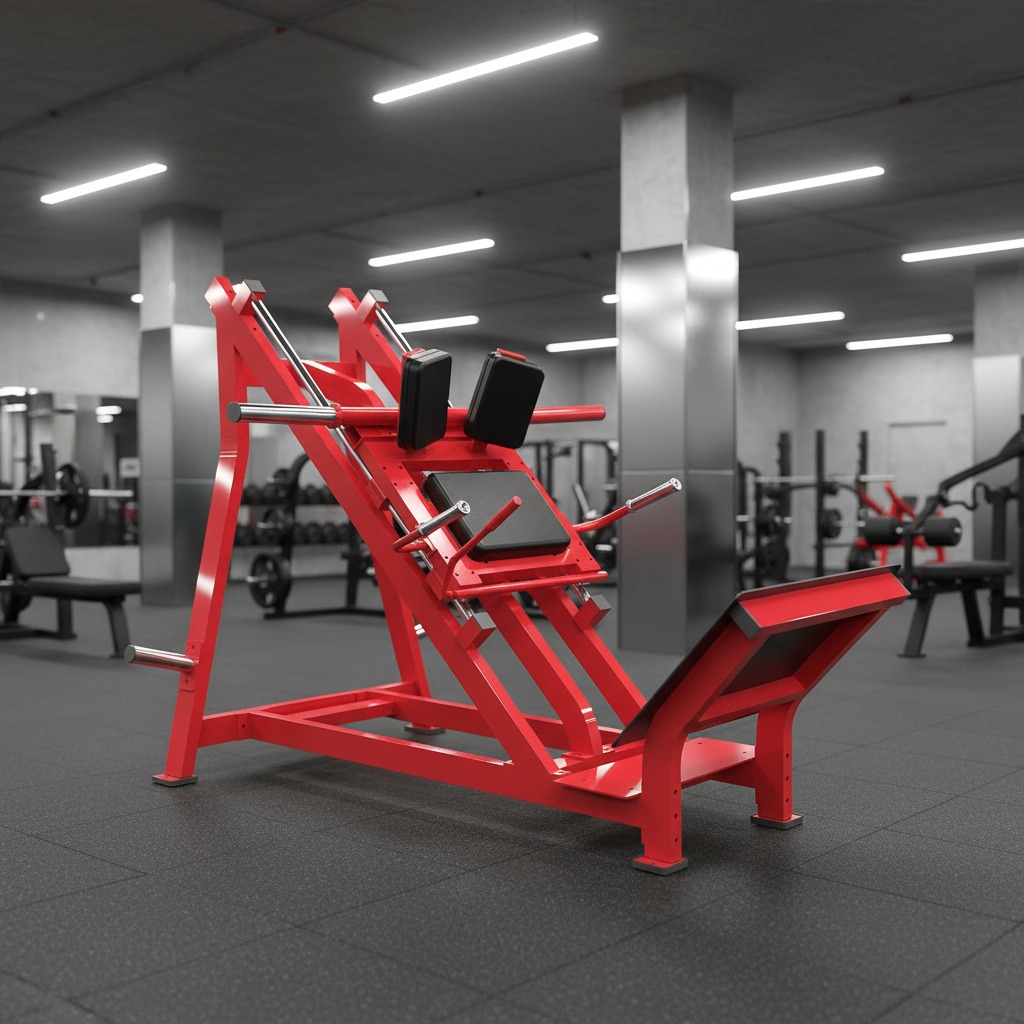
The product described here is a plate-loaded linear leg press / hack press machine. The visible layout suggests an inclined carriage moving along guided rails, with a large foot platform and padded shoulder/back contact points. In plain terms, it lets users load plates, brace against the pads, and drive through knee and hip extension along a controlled path.
That controlled path matters. It reduces the skill barrier compared with barbell squats and gives users a way to train legs under load when balance, mobility, or coaching bandwidth is limited. For a commercial operator, that means more people can use the machine safely with minimal instruction. It also means less bottlenecking than you get around a single squat rack during peak hours.
Quick buyer takeaways
The visible design points to several practical advantages. It is plate-loaded, so there is no selectorized weight stack to manage. It has a wide welded base, which usually helps with stability on the floor. It also includes multiple loading pegs or storage horns, which is convenient in a busy gym where plates need a temporary home.
At the same time, buyers should keep one caution in mind: large guided lower-body machines can look straightforward, but they occupy meaningful space and need a floor plan that accounts for the sled path, loading access, and user entry/exit. In a tight room, that matters more than the color of the frame.
How the construction affects everyday use
The visible structure appears to be fabricated steel with a bright red finish, chrome or polished guide components, and black upholstered pads. That combination is common in commercial fitness equipment because it balances durability, movement precision, and user comfort. The welded frame and wide footprint suggest the machine is intended for repeated commercial use rather than occasional home-gym duty.
The inclined rails or shafts are especially important. In a linear leg press, the quality of the guide system influences how smooth the carriage feels under load. Buyers usually cannot judge bearing design or rail tolerances from a photo, so it is worth asking the supplier how the carriage is guided and how service parts are handled. That is the sort of detail that separates a machine that stays in rotation from one that gets sidelined after a rough year of heavy traffic.
What to check before placing an order
Ask for the footprint, shipping weight, assembly requirements, and floor anchoring guidance if applicable. Also confirm whether the machine is intended for standard plate storage or only active loading. Since exact dimensions and load ratings are not provided here, do not assume a machine of this type will fit a space just because it looks compact in a product image.
Where this type of machine fits best
Commercial gyms are the obvious fit, but this is not the only one. Strength-and-conditioning rooms often value guided lower-body work because it complements squat patterns without overtaxing coaching resources. Athletic training centers may use it for accessory work, controlled volume, or return-to-training progressions. Rehab-oriented facilities sometimes like the confidence a guided press gives users, although that depends on the medical programming and the facility’s policies.
Home-gym buyers may also consider it, but usually only if ceiling height, room depth, and plate storage are not problems. A machine like this is not a casual purchase. It is a commitment to a particular training style.
Common mistakes buyers make with large leg machines
The first mistake is underestimating space. The second is assuming every member will use the machine the same way. Some will treat it as a heavy builder for quads and glutes; others will prefer higher-rep leg work with lighter loading. If the footplate angle, shoulder pad position, or carriage start point is awkward for a broad range of body sizes, usage drops fast.
A third mistake is focusing only on the frame and ignoring serviceability. A heavy steel machine can still become frustrating if the upholstery wears quickly, the guide system is hard to maintain, or replacement parts are slow to source. That is true for almost all strength training equipment, but especially for plate-loaded units that see aggressive use.
How to compare this against other cardio and strength purchases
If a facility is choosing between another leg machine, a treadmill, or a plate-loaded lower-body unit, the decision should follow member mix. A treadmill serves broad cardio demand and can be a daily traffic generator. This leg press serves a narrower but often very loyal segment: lifters, athletes, and members who care about visible strength progress. A balanced floor plan usually needs both, but not in equal measure.
That is the practical tradeoff. Cardio equipment tends to draw volume; heavy resistance machines tend to deepen training value. For many operators, the right answer is not either/or. It is whether the next purchase fixes the actual bottleneck in the room.
Buyer advice before you spec the machine
Request clear photos or drawings of the loading area, carriage path, and pad arrangement. Confirm whether the finish is powder-coated or painted, and whether the upholstery is vinyl-covered foam or another material. Those details are not cosmetic; they affect cleaning, wear, and long-term appearance in a commercial setting.
If possible, compare the machine with other lower-body units already in the facility. Does it complement a squat rack, hack squat, or leg extension/curl station? Or does it duplicate what you already have? The best purchases usually solve a usage problem, not just a floor-plan problem.
Next step for sourcing teams
If you are evaluating this kind of machine for a gym, training room, or wellness facility, build your decision around space, serviceability, and member use case before you lock in aesthetics. A well-built plate-loaded press can carry a lot of value, but only when it fits the program and the room.
For the next round of vendor comparison, ask for technical drawings, maintenance guidance, and a clear explanation of how the carriage system is constructed. That will tell you more than a polished sales sheet ever will.