
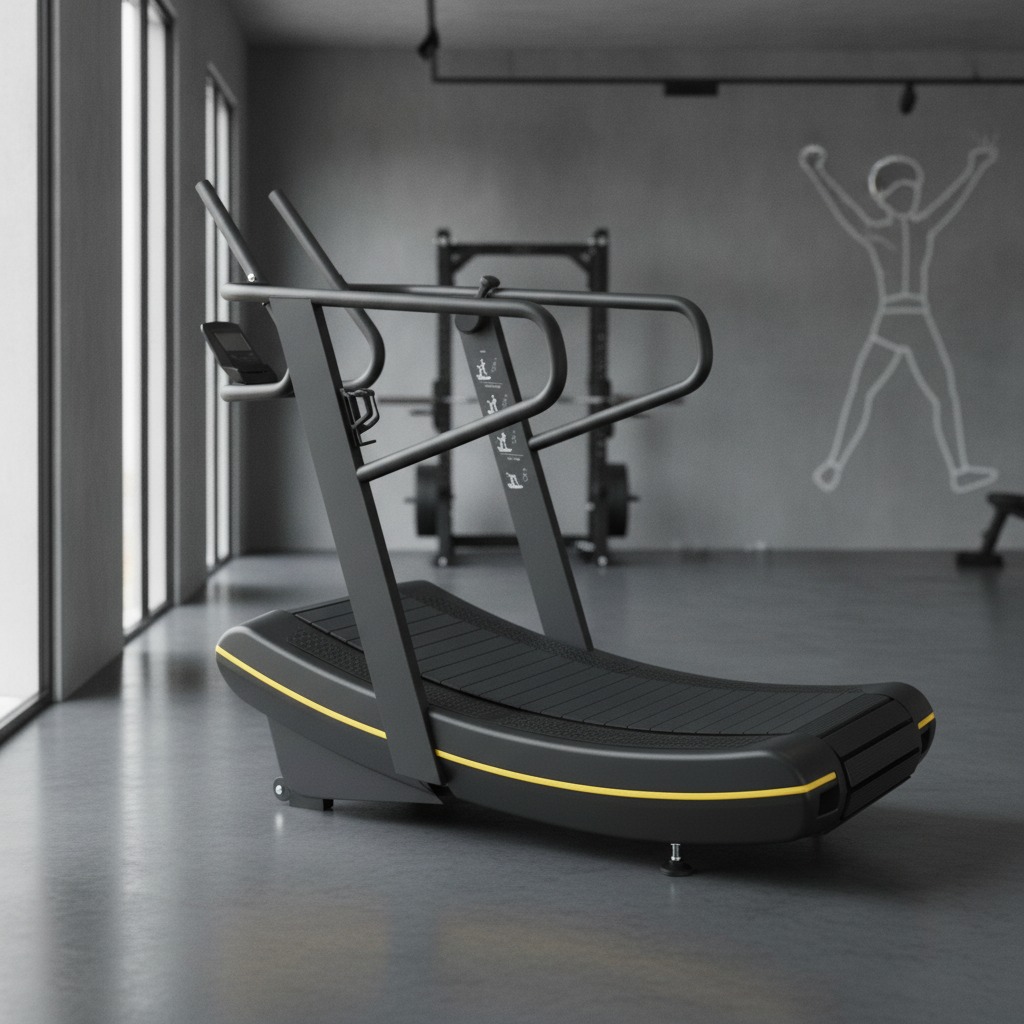
Why buying the right strength training equipment is never just about racks and plates
When buyers talk about strength training equipment, they usually start with the obvious pieces: racks, benches, dumbbells, cable stations, maybe plate-loaded machines. But the actual purchase decision is broader than that, especially for commercial gyms and training studios that need to support warm-ups, conditioning, and recovery without crowding the floor. A piece like a non-motorized curved treadmill sits in that border zone between strength work and conditioning work, and that matters more than it first appears.
For an engineer, sourcing manager, or product team, the real question is not whether the machine looks impressive. It is whether the equipment mix helps users train hard, move safely, and use the space efficiently. In many facilities, one well-chosen cardio unit can support sprint intervals, low-speed walking, and athletic conditioning while taking less floor space than a standard treadmill. That is a useful tradeoff, but only if the build quality, structure, and user experience hold up under daily use.
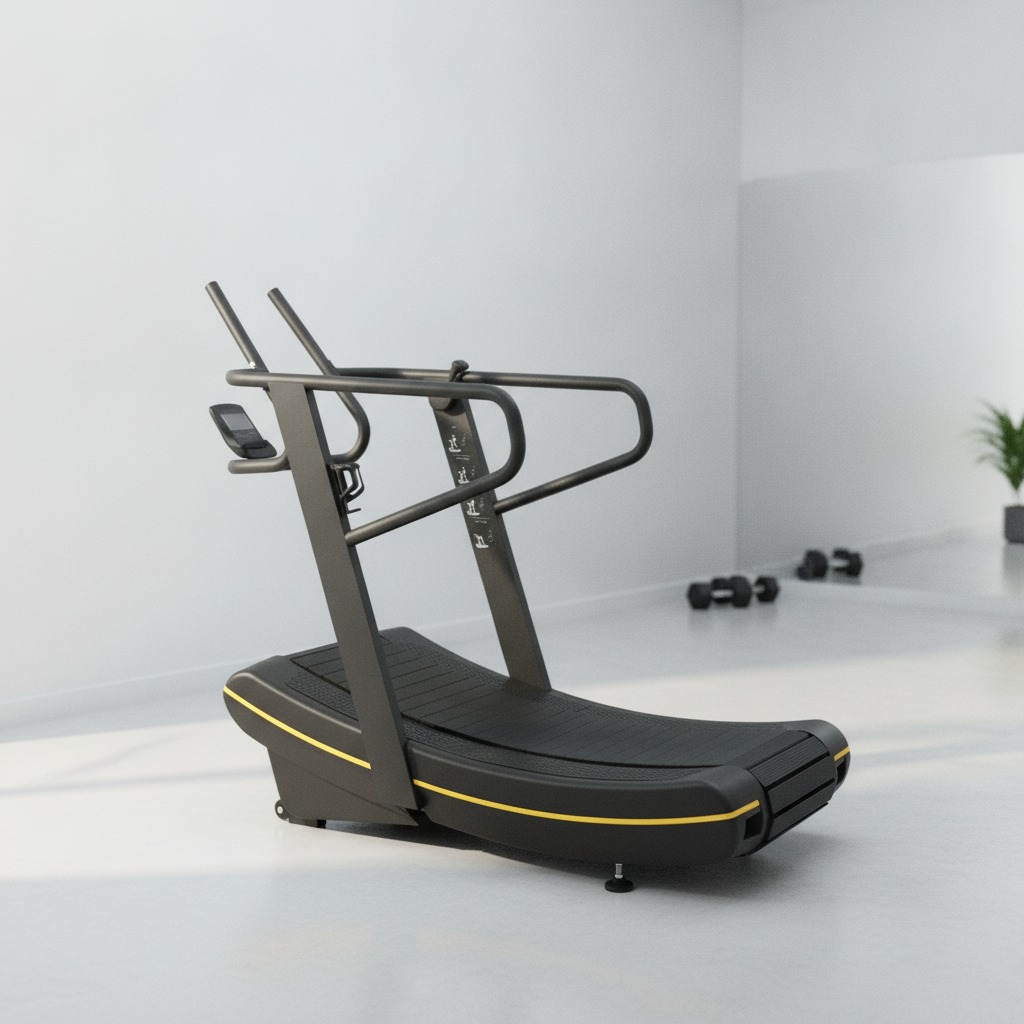
What the curved, self-powered treadmill tells you at a glance
The product described here is a curved running machine with a motorless, self-powered profile. The user drives the belt with their stride, which changes how pace is controlled. Instead of pressing buttons and waiting for a programmed motor response, the runner has to position their body and shift effort directly. That makes the machine attractive for sprint work and interval training, where immediate feedback is part of the appeal.
Visually, the unit appears to use a dark matte black frame, side shrouds, and a textured running surface. Two upright support posts and continuous tubular handrails suggest an emphasis on stability, which is worth noting for mixed-user environments. A small front console is present, though its functions are not readable from the image. The overall footprint also looks relatively compact compared with a conventional motorized treadmill, though exact dimensions are not provided and should be confirmed before layout planning.
How this fits into a broader gym equipment plan
Not every facility needs the same mix of gym equipment. A strength-focused space may want conditioning tools that complement lifting without stealing too much square footage or electrical capacity. This is where a curved treadmill can be a practical addition. It can support high-intensity intervals after barbell work, provide a warm-up option before lower-body sessions, or offer a change of pace for athletes who want a more force-driven running experience.
For commercial operators, that versatility helps on the revenue side too. A machine that serves multiple user types is easier to justify than one that only attracts a narrow audience. Still, the buyer should keep one caution in mind: a self-powered treadmill is not a drop-in substitute for every cardio need. Some users want guided speed control, pre-set workouts, or heavier console features. Others may need lower-impact options that a curved deck does not solve. The equipment should fit the training concept, not the other way around.
Material and construction details buyers should care about
From a manufacturing standpoint, the structure appears consistent with fitness equipment manufacturing practices: a welded steel frame, molded or thermoformed covers, and assembled running components. The dark finish and side housings suggest a design that tries to hide the moving elements and reduce visual bulk. That is normal for commercial equipment, but it also means buyers should ask about service access. A clean exterior can be nice; a unit that is difficult to inspect is not.
The curved belt surface and textured running deck are not decorative details. They affect traction, confidence during acceleration, and user comfort during the first few steps. Handrails on both sides also indicate that the machine is designed for more than just elite athletes. That can be helpful in rehabilitation-adjacent settings or for cautious users starting with walking intervals, provided the actual resistance and console settings support that use. Those functional details are not visible here, so they should be verified in product documentation.
Selection criteria that separate a good buy from an expensive mistake
When evaluating this kind of workout equipment, buyers should focus on a few practical points rather than marketing language.
1. User profile
If the main users are sprinters, team-sport athletes, or interval-focused members, the self-powered curved format makes sense. If the audience is mostly casual walkers, the fit is less obvious unless the unit has smooth resistance and an intuitive console.
2. Floor space and traffic flow
The compact-looking footprint is a plus, but curved treadmills still need clear entry and exit space. In a crowded training floor, the narrow, elongated shape can be an advantage. Then again, it can also create a bottleneck if placed too close to dumbbell bays or sled lanes.
3. Maintenance and serviceability
Self-powered systems reduce dependence on motors, but they still have wear parts. Buyers should ask how the belt, deck, bearings, and console assemblies are serviced. A unit that is hard to maintain becomes a downtime problem, and downtime is expensive in any commercial setting.
4. User guidance
Because speed is controlled by the runner, first-time users may need coaching. That is not a flaw, but it is a real operational detail. Staff should know how to explain the machine so users do not treat it like a conventional treadmill.
Common mistakes when sourcing cardio and strength-adjacent gear
One common mistake is buying by appearance. A curved running machine can look premium and athletic, but the real question is whether it suits the training model. Another mistake is assuming every self-powered treadmill behaves the same. Console feedback, resistance feel, handrail layout, and belt response can vary in ways that matter to end users.
Buyers also sometimes underestimate noise and floor vibration. Even without a motor, a hard-used unit in a busy training studio can still transmit impact. If the machine is going into a home gym, that issue becomes even more important. It is a small warning, but a worthwhile one: “motorless” does not automatically mean “quiet.”
Practical buyer advice before you place an order
Ask for the product sheet, not just the photo. Confirm dimensions, supported user weight, resistance behavior, console functions, and service parts availability. If the machine will sit near other cardio equipment, check how users enter and exit from both sides. If it will be part of a broader strength-and-conditioning floor, make sure it does not interfere with racks, sled paths, or dumbbell zones.
If possible, test how the belt responds to light jogging, faster acceleration, and short intervals. A unit that feels smooth at walking pace may behave differently under sprint load. That is the kind of detail that rarely shows up in a catalog, but it is exactly what buyers end up discussing after delivery.
FAQ: what buyers usually ask
Is a curved treadmill better than a standard treadmill?
Better for some training goals, not all. It is often strong for intervals and self-paced running, but less universal than a conventional motorized machine.
Can this replace other gym equipment?
No. It should be treated as a conditioning tool that complements strength training equipment, not as a substitute for racks, free weights, or cable systems.
Is it suitable for rehabilitation?
Potentially, yes, but only if the machine’s actual resistance feel, stability, and console settings support that use. The image alone does not confirm those details.
What to do next
If you are building a facility layout or refreshing a product line, use this machine as a benchmark for how modern gym equipment can bridge strength and conditioning. Request the full specification sheet, compare it against the training intent, and check serviceability before you commit. That is usually where the real buying decision gets made.